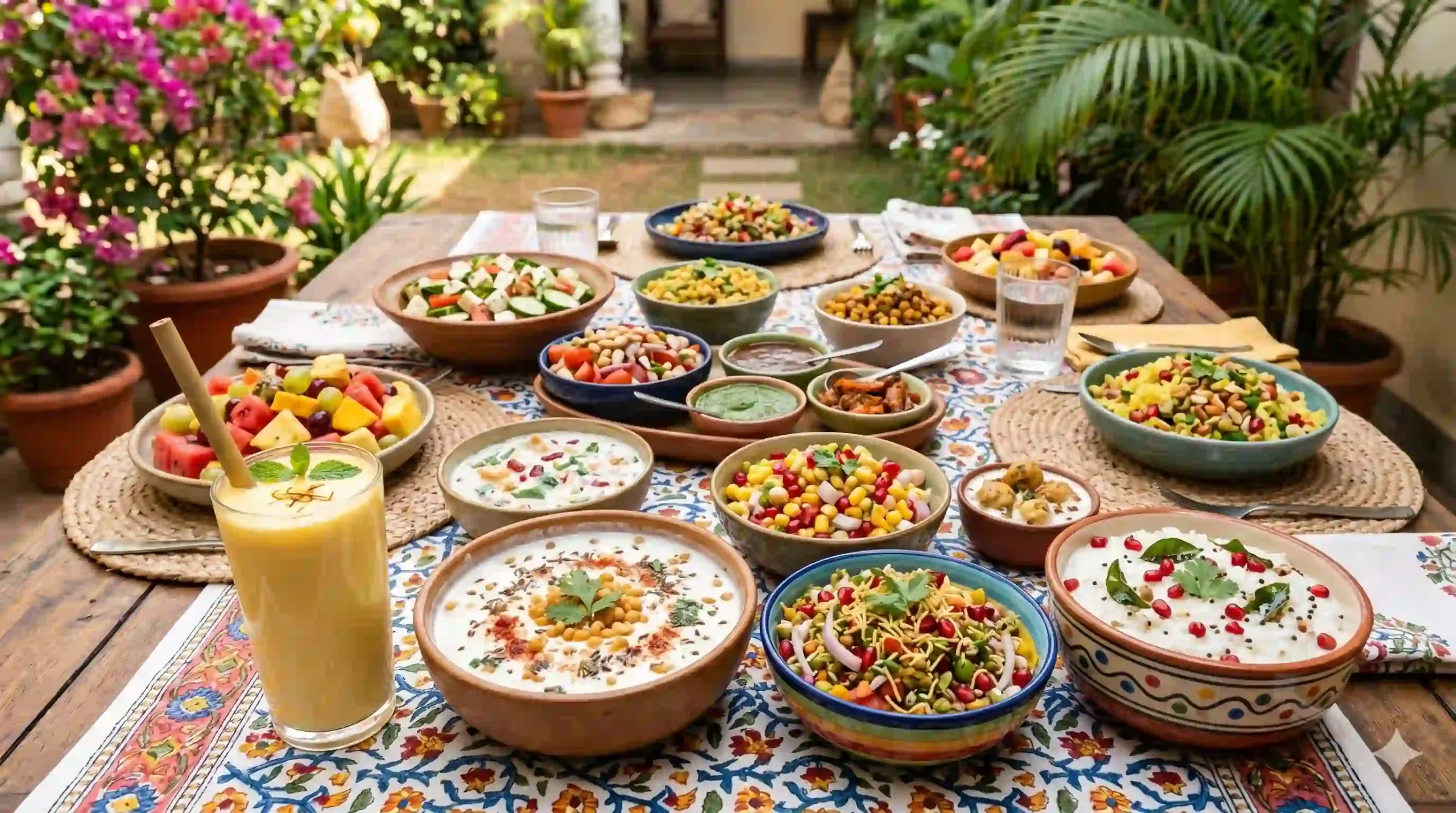
It is 43 degrees outside. The kitchen feels like a furnace. And yet, somehow, you still need to feed yourself and your family something that is filling, tasty, and actually Indian.
Here is the thing most people forget: Indian cuisine was never only about the stove. Long before modern kitchens existed, families across Rajasthan, Maharashtra, Tamil Nadu, and Gujarat were putting together meals that required no fire at all — dishes made from fresh yogurt, raw fruits, soaked legumes, and a handful of spices. These recipes did not survive for centuries by accident. They survived because they work. Especially in summer.
This guide brings together 15 of the best no-cook Indian summer recipes — drinks, mains, snacks, and desserts — that you can assemble in ten minutes or less. Every dish here is 100% authentic, nutritionally sound, and genuinely refreshing. No shortcuts. No excuses to turn on the stove.
And when the weather finally cools down and you are ready to cook again,
our guide to the
essential smart kitchen appliances for 2026 will help you upgrade
your setup for the season ahead.
“The best summer cooking is often the cooking you do not do at all.”
Why No-Cook Recipes Make Perfect Sense for an Indian Summer
Most people think of Indian cooking as something elaborate — a long list of spices, a hot tawa, and at least forty-five minutes of standing over heat. And yes, that version exists. But it is not the only version, and in the peak of summer, it is probably not the smartest version either.
There are some very practical reasons why skipping the stove in summer just makes sense:
- Cooking adds heat to your home. In cities like Delhi, Nagpur, and Lucknow where temperatures regularly cross 42°C in May and June, the last thing your kitchen needs is more heat from a gas burner.
- Cooking adds heat to your home. In cities like Delhi, Nagpur, and Lucknow
- where temperatures regularly cross 42°C in May and June, the last thing
- your kitchen needs is more heat from a gas burner.
- Heavy, cooked meals slow digestion. Ayurvedic practitioners have noted for centuries that the body’s digestive capacity — called agni — naturally weakens in intense heat. Lighter, fresh foods are easier for the body to process.
- Summer produce in India — raw mango, cucumber, tomato, coconut, pomegranate — is at its peak and almost always eaten raw or minimally processed anyway.
- Your time is better spent in a cool room than in a hot kitchen. That is not laziness. That is good judgement.
The good news is that Indian cuisine offers a remarkably rich tradition of no-cook eating. From the chaats of Mumbai’s streets to the curd rice of Chennai’s lunch tables, assembly-based Indian food is everywhere — it has just never been celebrated the way it deserves to be.
No-Cook Indian Summer Drinks: The Cool Foundation
Start with drinks. In an Indian summer, hydration is not just about comfort — it is a health necessity. These drinks go beyond plain water and deliver electrolytes, probiotics, vitamins, and flavour all at once.
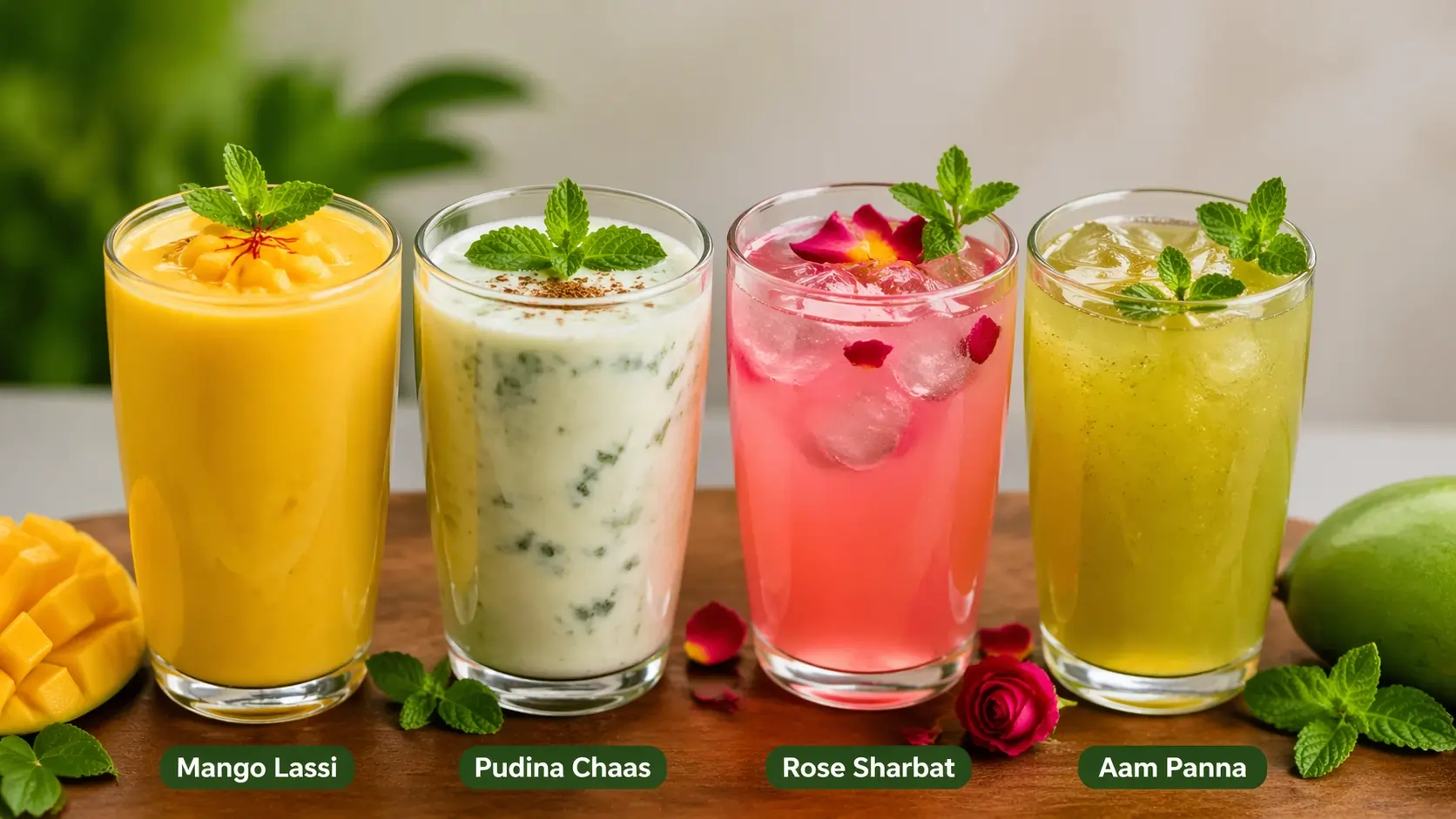
Cooling Indian summer drinks ready in minutes — no cooking required1. Mango Lassi
If there is one drink that defines Indian summer, it is this one. Take ripe Alphonso or Kesar mango pulp — fresh or tinned — and blend it with full-fat chilled yogurt, a small pinch of cardamom powder, and cold water or milk. That is it. No cooking, no heating, no fuss. The result is creamy, sweet, faintly aromatic, and deeply satisfying.
Tip: Use frozen mango cubes if fresh mango is not available. They make the lassi naturally cold without needing ice, which can dilute the flavour.
If you do plan to blend your mango lassi or aam panna, investing in a good
smart kitchen device can make the process even faster and more efficient.
2. Pudina Chaas (Spiced Mint Buttermilk)
This is arguably India’s oldest summer drink. Whisk fresh yogurt with cold water until completely smooth. Add a generous handful of fresh mint leaves, roasted cumin powder, black salt (kala namak), and a pinch of chaat masala. Blend or muddle the mint directly in. Strain if you prefer it smooth, or leave it as-is for a rustic texture.
Pudina chaas has genuine cooling properties. Mint’s menthol triggers cold receptors in the body, and the lactic acid in buttermilk supports gut health — both of which are especially valuable when temperatures are high.
3. Rose Sharbat with Sabja Seeds
This is as simple as it gets and somehow still manages to be extraordinary. Soak a tablespoon of sabja seeds (sweet basil seeds, not chia) in cold water for ten minutes. They will swell up and turn translucent with a soft jelly-like exterior. Add rose syrup — the classic Rooh Afza works beautifully — and top with chilled water or cold milk. Stir, drink, repeat.
Sabja seeds are not just a textural novelty. They absorb several times their own weight in water and release it slowly, keeping you hydrated far longer than a plain glass of water would.
4. Aam Panna (Raw Mango Cooler)
Traditional aam panna is made by roasting raw mangoes. But here is a no-cook shortcut that tastes nearly identical: blend raw mango pulp (scraped from peeled raw mangoes) with jaggery or sugar, roasted cumin powder, black salt, and fresh mint. Add cold water, stir until the sweetener dissolves, and serve over ice. The result is tangy, earthy, slightly smoky, and deeply refreshing.
Raw mango is rich in Vitamin C and potassium, which makes aam panna a genuinely effective drink for preventing heat exhaustion — a fact Indian grandmothers have always known and nutritionists are only now confirming in research papers.
Yogurt-Based No-Cook Indian Meals: Cool, Complete, and Satisfying
Yogurt — dahi in Hindi — is the single most important ingredient in Indian no-cook summer cooking. It is a complete food: protein-rich, probiotic, calcium-dense, and genuinely cooling. Once you understand how versatile it is, you will realise that a tub of good dahi can feed a family of four in summer without a single flame being lit.
5. Curd Rice (Thayir Sadam)
This is South India’s greatest gift to summer eating. Mash leftover cooked rice — the rice can be from the previous day’s lunch or dinner — while it is still slightly warm, then mix in a generous quantity of fresh yogurt and a pinch of salt. Let it rest until it reaches room temperature, then refrigerate. Before serving, top with pomegranate seeds, finely grated ginger, a few curry leaves if you have them, and a drizzle of good-quality sesame oil.
The mashing and mixing takes about three minutes. The result is a dish that has been eaten across Tamil Nadu, Karnataka, and Andhra Pradesh for generations — and for very good reason. It is light, cooling, gut-friendly, and surprisingly filling.
6. Boondi Raita
Soak plain boondi in cold water for five minutes until they soften slightly. Meanwhile, whisk chilled yogurt with roasted cumin powder, chaat masala, a pinch of red chilli powder, and salt. Squeeze excess water from the boondi, fold them into the curd, and garnish with fresh coriander. Done. This takes five minutes and pairs brilliantly with any flatbread or as a standalone snack.
7. Cucumber Raita
Grate or finely chop cucumber — no need to peel if the skin is tender. Squeeze out excess water. Mix into whisked curd with roasted cumin, salt, and fresh mint. This is one of those dishes that is greater than the sum of its parts. The cucumber adds a clean freshness that plain curd does not have on its own.
8. Dahi Bhalle (No-Fry Assembly Version)
This feels like cheating but is entirely legitimate: buy ready-made, vacuum-packed soft urad dal vadas from a trusted supermarket. Soak them in cold water for twenty minutes until completely soft. Place in a serving bowl, pour generously over with chilled sweetened curd, drizzle tamarind chutney and green mint chutney, sprinkle chaat masala and red chilli powder, and finish with fine sev and pomegranate seeds. Zero cooking. Maximum impact.
Nutritional note: Full-fat fresh dahi consumed at lunch time is widely recommended by nutritionists during Indian summer. The lactic acid helps regulate digestion, and the probiotics support immunity — both of which come under stress during extended heat exposure.
No-Cook Indian Chaats and Salads: Full of Flavour, Zero Heat
India’s chaat culture is almost entirely a no-cook tradition. The art of chaat lies in layering — textures, temperatures, and flavours assembled at the moment of eating. Nothing here requires a stove.
9. Sprout Chaat
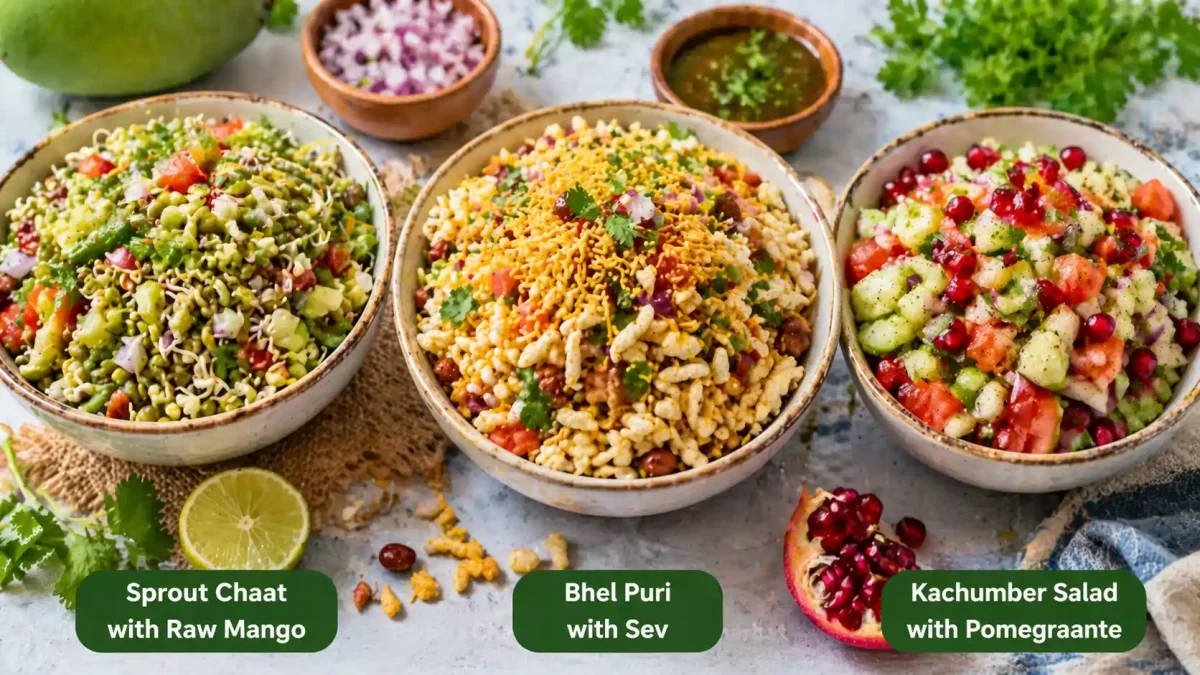
Sprouted moong beans or kala chana are among the most nutritious foods you can eat. When legumes sprout, their Vitamin C content increases dramatically — some studies suggest by 200 to 300 percent — and they become significantly easier to digest. To make sprout chaat: combine sprouted moong with finely diced raw mango, tomato, red onion, and green chilli. Add lemon juice, chaat masala, kala namak, and a handful of fresh coriander. Toss and serve immediately.
Sprouting takes 24 to 36 hours but requires no active effort — just a jar, water, and a cloth cover. Start a batch every two days and you will always have fresh sprouts on hand.
10. Kachumber Salad
Kachumber is not a salad in the Western sense. It is sharper, more assertive, and more interesting. Dice cucumber, ripe tomato, and red onion into small, even pieces. Add finely chopped green chilli, a squeeze of lemon, chaat masala, roasted cumin powder, and salt. Toss well and let it sit for two minutes before serving. The vegetables release their juices slightly and the whole thing becomes something much more than the individual parts.
11. Bhel Puri
Toss puffed rice with fine sev, finely chopped raw onion, tomato, boiled potato cubes, green chilli, and fresh coriander. Dress generously with tamarind chutney and green mint chutney. Add chaat masala and a squeeze of lemon. Serve immediately — bhel puri waits for no one. It goes soft within minutes, so assemble and eat right away.
12. Fruit Chaat
Cut watermelon, musk melon, cucumber, and raw mango into bite-sized cubes. Add a pinch of kala namak, a squeeze of lemon, chaat masala, and fresh mint. This is the most underrated chaat of them all — cooling, hydrating, and surprisingly complex in flavour thanks to the seasoning.
No-Cook Indian Summer Desserts: Sweet Relief Without the Stove
Indian desserts often involve extended cooking — kheer, halwa, barfi. But summer has its own dessert canon, and it requires no cooking at all.
13. Shrikhand
Hang full-fat yogurt in a muslin cloth overnight in the refrigerator. By morning, the whey has drained out and you are left with thick, creamy chakka. Whisk this with sifted powdered sugar, a generous pinch of saffron soaked in a tablespoon of warm milk (technically a tiny amount of heat, but avoidable with cold milk saffron-soaking), and cardamom powder. Refrigerate and serve cold.
Shrikhand is one of Maharashtra and Gujarat’s finest culinary achievements. It is silky, deeply satisfying, and has exactly zero cooking involved beyond the overnight straining.
If you enjoy cold desserts without cooking, you will love these
blender ice cream hacks that deliver creamy frozen treats in under
sixty seconds — no stove, no fuss.
14. Aam Shrikhand (Amrakhand)
Exactly like shrikhand, but fold ripe mango pulp into the chakka before whisking. The result — called amrakhand — is one of the most purely pleasurable things you can eat in an Indian summer. Serve it with warm pooris at a traditional Maharashtrian lunch or eat it straight from the bowl as a dessert. Both are acceptable.
15. Kesar Chia Phirni (No-Cook Version)
Soak chia seeds overnight in cold full-fat milk with saffron strands, powdered cardamom, and a spoon of sugar or jaggery. By morning the chia seeds have absorbed the milk and swelled into a thick, pudding-like texture that closely resembles the mouthfeel of traditional phirni — without a single minute of cooking. Garnish with slivered pistachios and a few strands of saffron. Serve chilled in small clay pots for full effect.
Your No-Cook Indian Summer Pantry: What to Keep Stocked
The only reason no-cook summer cooking sometimes feels effortful is a disorganised pantry. With the right staples always within reach, you can assemble any of the fifteen dishes above in under ten minutes. Here is exactly what you need.
Refrigerator Essentials
- Full-fat plain dahi — the foundation of at least eight recipes on this list. Make it at home if possible; it is thicker and fresher than commercial varieties.
- Fresh mint and coriander — store them upright in a glass of water in the fridge, covered loosely with a plastic bag. They last up to ten days this way.
- Ripe and raw mangoes — both varieties are needed for different recipes. Buy in bulk during April to July when prices are lowest and quality is highest.
- Cucumber, tomato, and red onion — the kachumber trinity. Always present.
- Pomegranate seeds — stored in an airtight container after seeding, they last five to six days and add instant colour and flavour to raitas, curd rice, and chaats.
- To make your summer kitchen setup even more efficient, check out our curated list of
- kitchen gadgets that are actually worth your money — several of them work
- beautifully for no-cook meal prep.
Pantry Shelf Staples
- Chaat masala, roasted cumin powder, kala namak — the three spices that appear in more than half the recipes here. Buy good quality and store in airtight containers away from heat.
- Tamarind chutney and green mint chutney — quality store-bought versions work perfectly well. MTR, Swad, and Patanjali all make reliable options.
- Puffed rice (murmura), boondi, and fine sev — for instant texture in chaats and snacks.
- Sabja seeds and chia seeds — for drinks and overnight desserts.
- Rose syrup (Rooh Afza) — one bottle lasts a season and turns cold water or milk into an instant dessert drink.
- Muslin cloth — for hanging curd to make chakka for shrikhand. A clean cotton dupatta works just as well.
- Many of the tools that make no-cook Indian summer cooking easier — quality
- blenders, muslin cloths, insulated tiffin boxes — are available as
- affordable Amazon kitchen finds that are worth adding to your home.
Why These Foods Actually Work: The Science and Ayurvedic Logic
There is a temptation to dismiss Ayurvedic food recommendations as folk wisdom with no scientific basis. But when it comes to summer eating, the overlap between traditional Indian dietary logic and modern nutritional science is remarkably close.
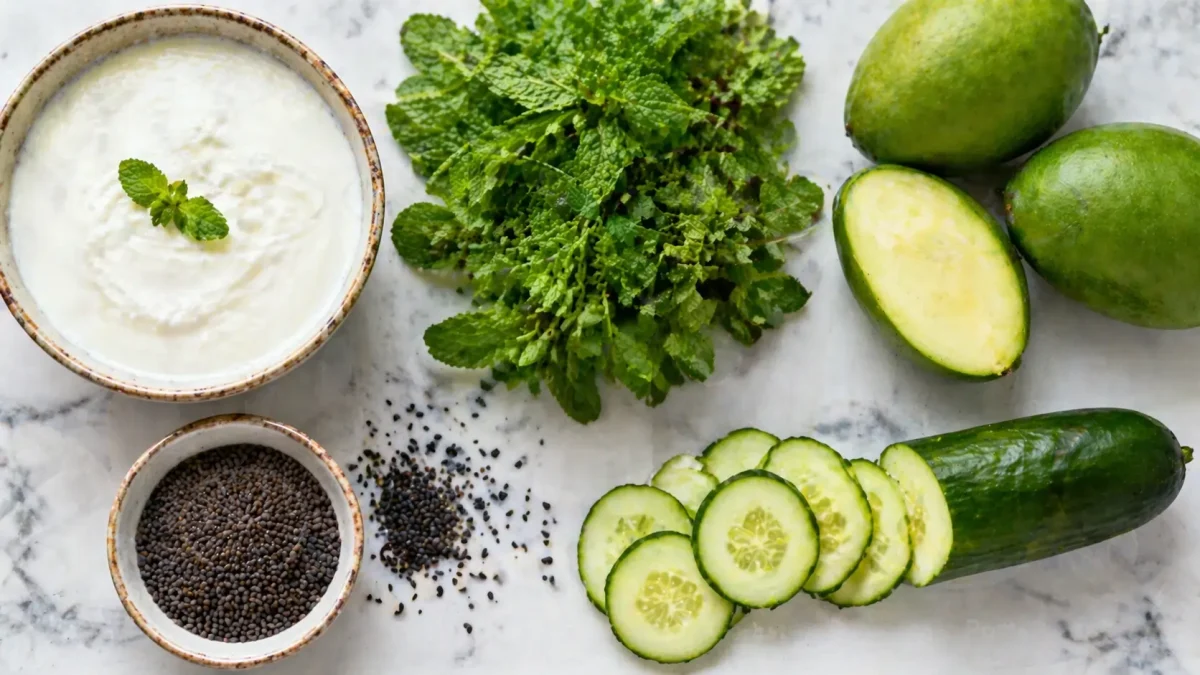
There is a temptation to dismiss Ayurvedic food recommendations as folk
wisdom with no scientific basis. But when it comes to summer eating, the
overlap between Ayurvedic dietary logic and modern nutritional science is remarkably close.
Ayurveda classifies foods as either ushna (heating) or sheeta (cooling). Foods like yogurt, cucumber, coconut, raw mango, and fresh mint are all classified as sheeta — cooling — and are specifically recommended during the summer months (called grishma ritu in Ayurvedic texts). Modern nutrition largely agrees:
- Yogurt contains probiotics that reduce gut inflammation, which increases in response to heat stress. It also provides electrolytes — particularly potassium and calcium — that are lost through sweating.
- Raw mango is an excellent source of Vitamin C and malic acid. Research published in food science journals consistently notes its role in preventing dehydration and supporting liver function during summer.
- Sabja seeds form a hydrophilic gel when soaked, releasing water slowly in the digestive tract — essentially a natural oral rehydration mechanism.
- Pudina (mint) contains menthol, which activates the TRPM8 receptor in the mouth and throat, creating a genuine cooling sensation without lowering core temperature.
- Sprouted legumes increase their bioavailable Vitamin C content significantly during the sprouting process, while simultaneously becoming easier to digest — which matters because summer heat slows the digestive system.
These are not coincidences. They are the result of centuries of observation, codified into a food culture that was engineered for the climate it grew up in.
Why This Matters Beyond the Kitchen
No-cook Indian summer cooking is not just a personal convenience. It has a broader relevance that deserves acknowledgment.
In many low-income households across urban and peri-urban India, cooking fuel — whether LPG or electricity — represents a significant monthly expense. During summer months when demand spikes, reducing cooking time is genuinely meaningful for household budgets. The dishes in this guide largely eliminate cooking-related fuel costs for the meals they replace.
There is also the question of who does the cooking. The majority of cooking labour in Indian households is still performed by women. Kitchens in Indian summers — particularly in homes without air conditioning — can reach temperatures that pose real health risks. No-cook meals directly reduce the amount of time spent in hot kitchen environments.
And then there is the broader climate picture. As South Asia’s heatwaves become longer and more intense in line with global climate trends, the revival of traditional cooling food practices is increasingly being framed by food researchers as a form of cultural climate adaptation — drawing on knowledge that was specifically evolved for hot environments, at a time when that knowledge is needed more than ever.
Key Takeaways
- Indian cuisine has a deep, centuries-old tradition of no-cook summer recipes that deserves far more recognition than it typically receives.
- 15 complete dishes — covering drinks, yogurt-based mains, chaats, salads, and desserts — can cover an entire day’s eating without a single flame being lit.
- Yogurt, raw mango, sabja seeds, mint, and sprouted legumes are the nutritional cornerstones of no-cook Indian summer eating — chosen by tradition and validated by modern science.
- A pantry stocked with around 12 core staples is all you need to assemble any of these dishes in ten minutes or less.
- No-cook summer cooking reduces kitchen heat, fuel costs, and cooking labour — all of which matter disproportionately in Indian summers.
- The Ayurvedic principle of cooling (sheeta) foods maps closely onto modern nutritional recommendations for hot-weather eating.
Explore More on This Topic
If you found these recipes useful, you might also enjoy reading about the complete guide to making Indian chaats at home, or dive into what Ayurveda recommends for your summer diet. For more refreshing options, our collection of the best Indian summer drinks covers everything from thandai to kokum sharbat. And if you have never sprouted your own legumes before, our beginner’s guide to sprouting moong at home is the perfect place to start.
Frequently Asked Questions
Can you get enough protein from no-cook Indian summer meals?
Yes, quite comfortably. Sprouted legumes like moong and kala chana provide seven to nine grams of protein per hundred gram serving. Yogurt adds another five to eight grams per serving. Combined across a day’s eating, these sources can meet a substantial portion of average daily protein requirements — particularly for moderately active adults. If you need more, add a handful of roasted peanuts, a serving of paneer eaten cold, or a glass of thick lassi.
Is it healthy to eat a lot of dahi every day during summer?
For most healthy adults, yes. Both Ayurvedic tradition and modern nutrition recommend fresh yogurt as a lunchtime staple during Indian summers. The probiotics support gut health, the electrolytes replace what is lost through sweating, and the cooling properties are genuinely felt. Choose full-fat, fresh homemade curd where possible over heavily processed commercial varieties. If you have a specific dairy sensitivity or lactose intolerance, chaas (which has a lower lactose content due to fermentation) is often better tolerated.
How do you keep no-cook meals safe to eat in Indian summer heat?
The main rule is simple: assemble immediately before eating, not hours in advance. Yogurt-based dishes and dressed chaats should not sit out for more than thirty to forty minutes at temperatures above 35°C. Keep all refrigerated components cold until the moment of assembly. If packing a lunch, use an insulated tiffin box with an ice pack. FSSAI guidelines recommend keeping dairy-based dishes below 5°C until consumption.
Are these recipes suitable for children and elderly family members?
Most of them are ideal for both groups. Curd rice, mango lassi, boondi raita, and shrikhand are all gentle on sensitive digestive systems and easy to eat. For elderly family members, skip or reduce the green chilli and chaat masala in chaats. For children, avoid very sour tamarind dressings until they develop a tolerance. The high water content and probiotic richness of these dishes makes them particularly beneficial for children and the elderly in summer, when dehydration and gut disruption are common concerns.
The Stove Can Wait — Summer Cannot
There is a particular kind of kitchen wisdom that does not get enough credit: knowing when not to cook. Indian cuisine, at its best, has always understood this. The raita on a scorching Jaipur afternoon. The curd rice at a Chennai lunch table in May. The bhel puri from a Mumbai cart on an evening when the heat has finally, mercifully, started to ease.
These dishes were not accidents or compromises. They were deliberate — designed by people who knew exactly what the body needed in the heat and built a culinary tradition around providing it.
The fifteen recipes in this guide are your starting point. Once you understand the pantry, the flavour logic, and the rhythm of assembly-based Indian cooking, you will find yourself improvising constantly. A container of leftover rice becomes curd rice in three minutes. A ripe mango becomes lassi in ninety seconds. A cup of yesterday’s sprouted moong becomes a complete, nourishing meal in seven minutes.
The stove will still be there when October comes. This summer, let it rest.
Tried any of these recipes? Share which one worked best for your family in the comments below — I would genuinely love to hear. And if someone you know is suffering through a hot kitchen this summer, send them this post. It might be the most useful thing they read all season.
📌 Save this post to your Pinterest board or bookmark it for easy access all summer long.