Your Private Chats Aren’t as Private as You Think
If you’ve been searching for encrypted messaging app reviews, here’s the quick answer:
Best encrypted messaging apps in 2026:
| App | Best For | Rating |
|---|---|---|
| Signal | Best overall privacy + usability | 4.5/5 |
| Session | Best for anonymous texting | 4.0/5 |
| Threema | Best Swiss-jurisdiction option | Recommended |
| Element | Best decentralized/self-hosted | Recommended |
| Wire | Best for enterprise teams | Recommended |
| SimpleX | Best for no user IDs at all | Recommended |
Apps to avoid: WhatsApp (Meta metadata collection), Telegram (no default E2EE), Facebook Messenger (data sharing history).
Think your messages are private? Here’s a sobering thought: whatever you’re talking about in WhatsApp or Telegram, there’s a real chance someone else can see it too — whether that’s advertisers, data brokers, or government agencies.
From advertisers to law enforcement, your personal information is big business in 2026. People are willing to pay for your private chat logs, photos, and messages to use in scams, identity theft, or blackmail.
The good news? Strong encryption exists. And some apps use it far better than others.
But not all “secure” apps are created equal. Some encrypt your messages but still harvest your metadata. Some require your phone number, linking your identity to every conversation. Others claim security without ever opening their code to independent review.
That’s exactly why reading real encrypted messaging app reviews — ones that dig into the technical details — matters so much before you trust an app with your private life.
Key Security Criteria for Encrypted Messaging App Reviews
When we dive into encrypted messaging app reviews, we aren’t just looking at how many stickers an app has or how pretty the UI looks. We look at the “engine” under the hood. In 2026, the digital landscape is more aggressive than ever, and a “secure” messenger is only as strong as its weakest link. Here are the non-negotiable criteria we use to evaluate these tools:
End-to-End Encryption (E2EE)
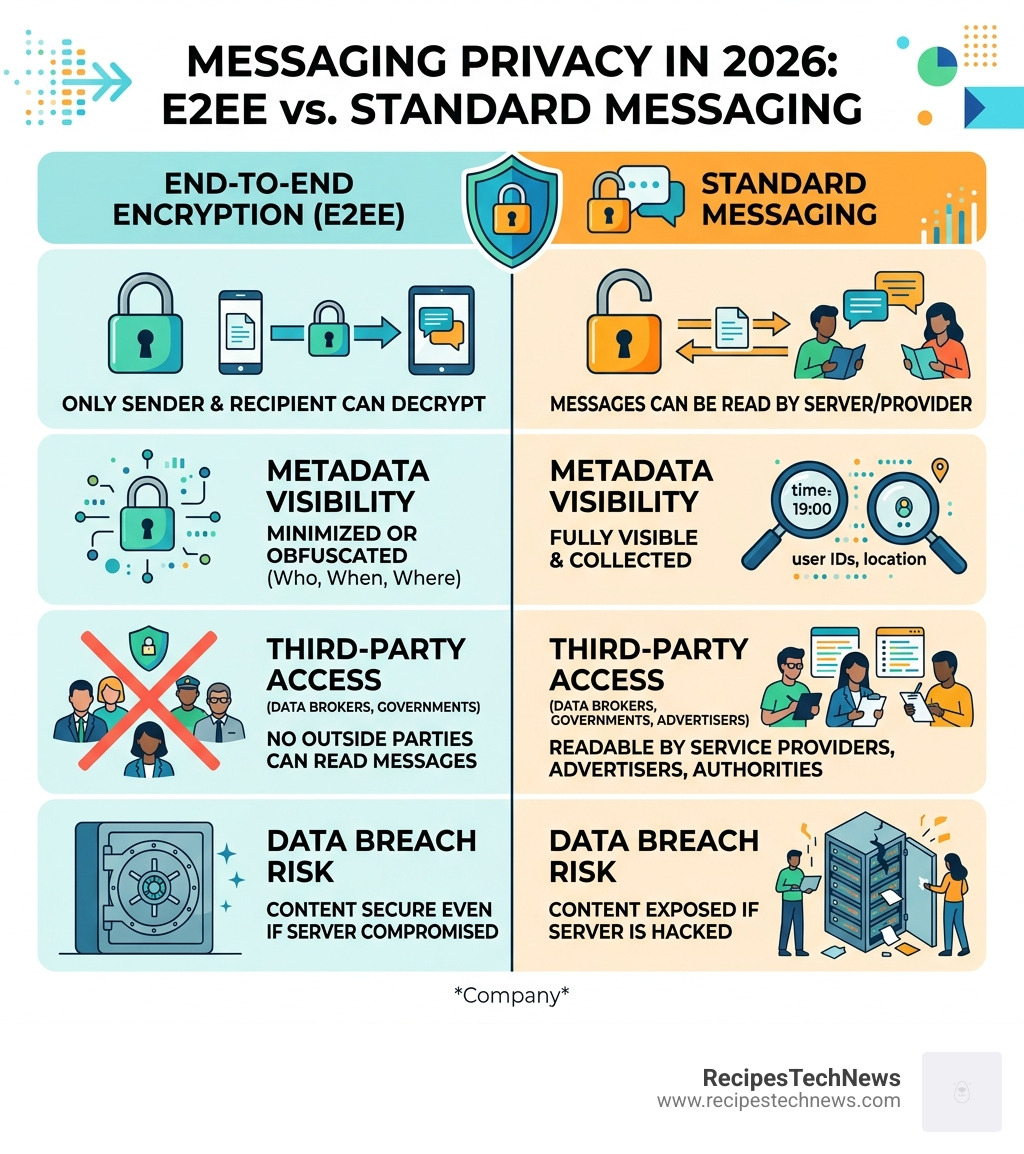
This is the baseline. E2EE ensures that only you and the recipient can read the content of a message. If the service provider (like Apple or Google) can technically peek at your messages to “improve service,” it isn’t truly secure. We look for apps where encryption is the default, not an “opt-in” feature.
Open-Source Code
Transparency is the enemy of backdoors. When an app is open-source, security researchers can audit the code to ensure the developers aren’t hiding vulnerabilities or data-sharing hooks. Proprietary, closed-source apps like WhatsApp or Skype require you to take the company’s word for it—and in 2026, “trust me” isn’t a security protocol.
Perfect Forward Secrecy (PFS)
PFS ensures that even if a hacker manages to steal your current encryption key, they can’t use it to decrypt your past messages. Each session or message uses a unique, temporary key. It’s like changing the locks on your house every time you walk through the door.
Metadata Minimization
Encryption hides what you said, but metadata reveals who you talked to, when, and where you were. Many “secure” apps still log your IP address and contact lists. The best apps in our encrypted messaging app reviews collect almost zero metadata.
Independent Security Audits and Reproducible Builds
We value apps that have undergone rigorous, third-party audits. Furthermore, “reproducible builds” allow tech-savvy users to verify that the code available on GitHub is the exact same code used to build the app you download from the store. You can learn more about how we handle data in our Privacy Policy.
For a deeper dive into one of the top contenders, check out this Signal Private Messenger Review.
Top 6 Recommended Secure Messengers for 2026
Choosing a messenger often involves a trade-off between absolute privacy and convenience. Below is a comparison of the top-rated apps we’ve tested this year.
| Feature | Signal | Session | Threema | Element | Wire | SimpleX |
|---|---|---|---|---|---|---|
| E2EE Default | Yes | Yes | Yes | Yes | Yes | Yes |
| Phone Required | Yes | No | No | No | No | No |
| Centralized | Yes | No | Yes | No | Yes | No |
| Open Source | Yes | Yes | Yes | Yes | Yes | Yes |
| Audit Date | 2025/26 | 2024 | 2025 | 2024 | 2024 | 2025 |
Signal: Best Overall
Signal remains our top pick for 2026 because it strikes a perfect balance. It’s as easy to use as WhatsApp but offers uncompromising security. It is run by a nonprofit, meaning there are no shareholders to please or data to sell.
Session: Best for Anonymity
If you want to disappear, Session is your tool. It uses onion routing (similar to Tor) to bounce your messages through multiple nodes, hiding your IP address and requiring no phone number or email for signup.
Threema: Swiss Jurisdiction
Based in Switzerland, Threema benefits from some of the world’s strongest privacy laws. It’s a paid app, which means you are the customer, not the product.
Element: Decentralized Matrix
Element runs on the Matrix protocol, allowing you to host your own server. This decentralization means no single company controls your data or can shut down your communication.
Wire: Enterprise Security
Wire is excellent for teams that need secure file sharing and conference calls. While it collects slightly more metadata for syncing purposes than Signal, it offers a robust environment for professional use.
SimpleX: No User IDs
SimpleX takes a radical approach: it doesn’t even use a “User ID.” Instead, it uses temporary addresses for every contact, making it nearly impossible to build a profile of your social graph. For more insights on digital safety, visit our Blogs section.
Signal: The Gold Standard in Encrypted Messaging App Reviews
Signal continues to hold its 4.5/5 “Outstanding” rating because of its relentless focus on privacy. Unlike big tech companies, Signal is a 501(c)(3) nonprofit. They don’t want your data; they want your privacy.
The “Signal Protocol” is so secure that even Google and Meta have integrated it into their own platforms—though they often leave out the metadata protections that make Signal unique. One of Signal’s standout features in 2026 is its ability to verify identities using random two-word phrases during calls, ensuring no “man-in-the-middle” is listening.
The main drawback remains the phone number requirement for registration. However, Signal has introduced features to hide your number from other users once you’ve signed up. For those in the UK, you can find a specific Signal Private Messenger – Review 2026 – PCMag UK to see how it performs across the pond.
Session and SimpleX: Leading the Way for Anonymous Encrypted Messaging App Reviews
For users who find Signal’s phone number requirement a dealbreaker, Session and SimpleX are the 2026 frontrunners.
Session is built for those who fear surveillance. By utilizing a decentralized network of “service nodes,” it ensures that no single server knows both the sender and the recipient of a message. It effectively strips away the “who is talking to whom” metadata that most other apps leave behind.
SimpleX, on the other hand, is the first messaging platform that has no user identifiers—not even a random number. It uses a “double-layered” encryption approach that makes it our top recommendation for whistleblowers and journalists. You can read more about these high-security options in this Signal Private Messenger – Review 2026 – PCMag Middle East review, which often compares these alternatives.
Why Mainstream Apps Like WhatsApp and Telegram Often Fail Privacy Standards

It’s easy to be lulled into a false sense of security by apps like WhatsApp. After all, it says “Messages are end-to-end encrypted” right at the top of every chat. But in encrypted messaging app reviews, we have to look at the parent company.
The Meta Problem (WhatsApp)
While WhatsApp uses the Signal Protocol for encryption, it is owned by Meta. WhatsApp collects a staggering amount of metadata: who you message, how often, your IP address, your signal strength, and even your battery level. This data is used to build a “shadow profile” of you, which is then linked to your Facebook and Instagram accounts for ad targeting.
The Telegram Trap
Telegram is often marketed as a “secure” alternative, but it has significant flaws:
- Not E2EE by Default: Standard chats are stored on Telegram’s servers. To get end-to-end encryption, you must manually start a “Secret Chat.”
- Proprietary Encryption: They use their own protocol (MTProto), which has been criticized by cryptographers for being needlessly complex and less vetted than the Signal Protocol.
- Jurisdiction: Telegram’s shifting headquarters and lack of transparency regarding government data requests make it a risky choice for high-stakes privacy.
Government and Agency Ties
Research into Snowden-era revelations and more recent leaks suggests that mainstream apps are often the first targets for government backdoors. Apps like Amazon’s Wickr (now AWS Wickr) have faced scrutiny due to leadership with former intelligence ties. When an app is funded by CIA-linked venture capital or partners with the NSA, its “security” claims should be viewed with extreme skepticism. Check out our latest Blogs for updates on these developing stories.
Specialized Use Cases: From Offline Chats to Enterprise Security
Sometimes, you need more than just a standard chat app. Depending on your situation, you might require tools that work without the internet or offer extreme control over shared media.
Briar: The “Off-Grid” Choice
Briar is unique because it doesn’t rely on a central server. It can sync via the Tor network when the internet is available, but if the grid goes down (or is censored), it can sync via Bluetooth or Wi-Fi with people in the same building or street. It’s a vital tool for activists and emergency responders.
KeeperChat: The Zero-Knowledge Vault
KeeperChat, developed by the team behind the popular password manager, offers a “zero-knowledge” architecture. This means the developers have no way to access your data.
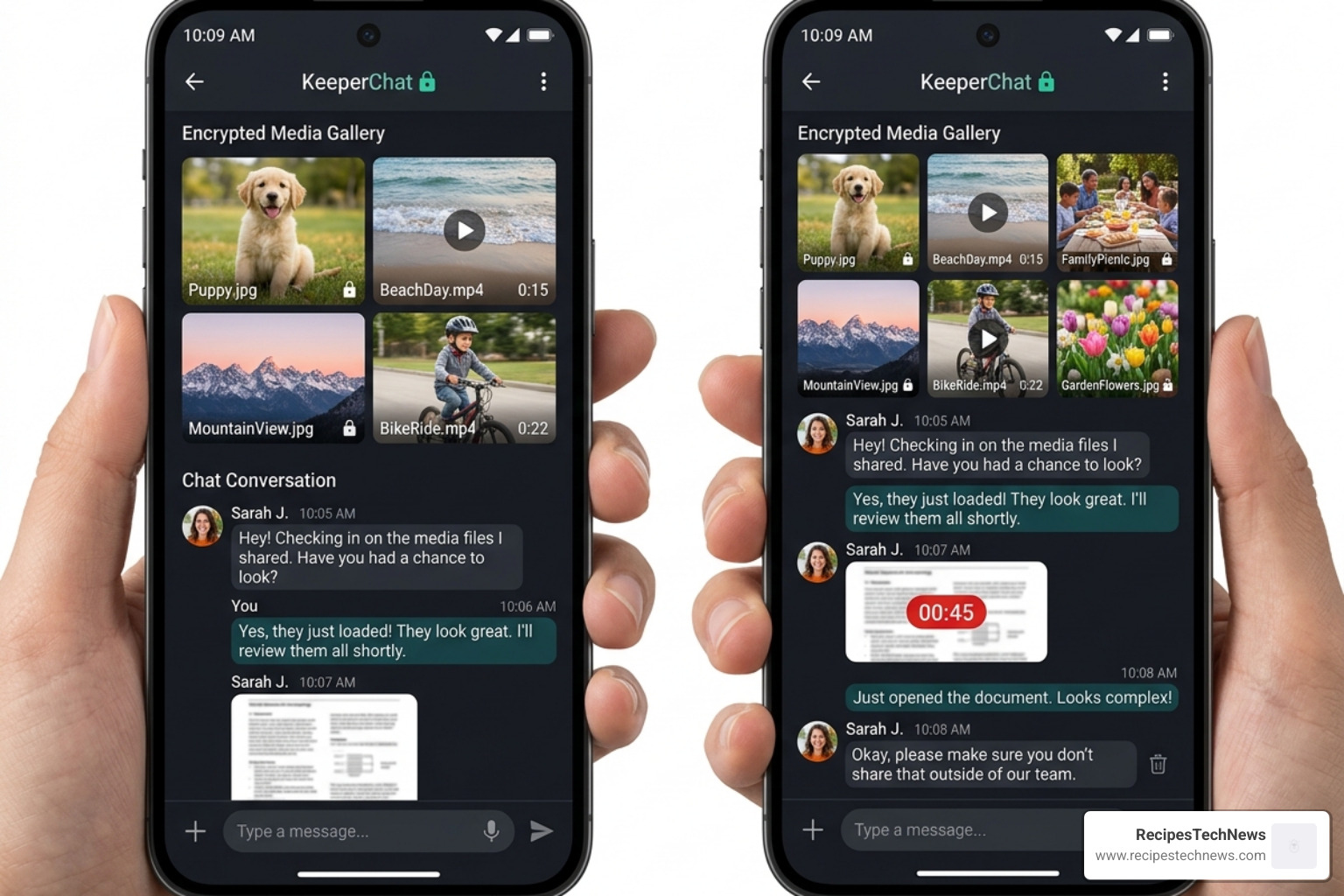
Standout features of KeeperChat include:
- Encrypted Media Gallery: Photos and videos are stored inside the app, not in your phone’s vulnerable “Camera Roll.”
- Screenshot Alerts: You get a notification if the person you’re chatting with takes a screenshot.
- Message Retraction: You can “un-send” a message at any time, and it disappears from both devices.
- Self-Destruct Timers: Set messages to vanish seconds after they are read.
For more information on the latest tech and gadgets, head over to our Homepage.
Frequently Asked Questions about Secure Messaging
Which app is best for anonymous texting without a phone number?
In 2026, Session and SimpleX are the clear winners. Session uses an ID generated by your device, while SimpleX uses temporary connection links. Both apps route traffic through multiple servers to hide your IP address, ensuring that even the app developers don’t know who you are.
Are decentralized messaging apps more reliable than centralized ones?
Decentralized apps like Element (Matrix) are more resilient to censorship and server outages. If one server goes down, the rest of the network stays up. However, they can be slightly more complex to set up. Centralized apps like Signal are easier for the average user but represent a single point of failure if the company is ever forced to shut down.
How do independent audits impact the trustworthiness of a messenger?
An audit is a “health check” by experts who don’t work for the company. Signal, Threema, and Wire undergo these regularly. These audits ensure that the encryption is implemented correctly and that there are no “backdoors” for hackers or agencies. We always prioritize audited apps in our encrypted messaging app reviews.
Conclusion
At RecipesTechNews, we believe that privacy isn’t about having something to hide; it’s about having something to protect. In 2026, the “snooping” isn’t just a theory—it’s a multi-billion dollar industry fueled by your personal conversations.
If you want the best all-around protection, Signal is your best bet. If you need total anonymity, look toward Session or SimpleX. For those who need to keep sensitive documents and media under lock and key, KeeperChat provides a specialized vault-like experience.
Don’t wait for a data breach or a privacy scandal to make the switch. Secure your digital life today by choosing a messenger that actually respects your boundaries. For more tech-lifestyle fusion content and the latest gadget reviews, keep an eye on our Homepage and read our full Privacy Policy to see how we stay committed to your security.