
Why the 10 Latest News About Computer Technology Matter Right Now
The 10 latest news about computer technology in April 2026 cover a fast-moving mix of AI power struggles, hardware shortages, cybersecurity threats, and robotics breakthroughs. Here’s a quick snapshot:
- Anthropic vs. Pentagon – CEO Dario Amodei heads to the White House over the Mythos AI model dispute
- AI-driven RAM shortage – Meta Quest 3 prices rising to $600; Surface prices climbing too
- Apple’s China comeback – iPhone shipments surged 20% in Q1 2026
- DeepSeek funding – China’s AI lab raising money at a $10 billion valuation
- Malicious traffic spike – A 245% surge in cyberattacks linked to the Iran war
- Emoji-based hacking – Hackers using emojis to evade detection in communications
- AI data center growth – Strong ASML and TSMC forecasts signal a sustained AI spending boom
- Gemini Robotics-ER 1.6 – DeepMind’s new model brings precise spatial reasoning to physical robots
- Adobe Firefly AI Assistant – Agentic AI now orchestrates tasks across Creative Cloud apps
- Meta layoffs and AI fraud charges – Big workforce cuts and executive indictments at a bankrupt AI firm
Tech in 2026 isn’t moving fast — it’s sprinting. Governments are clashing with AI companies over who controls the most powerful models. Hardware prices are climbing because AI is eating up RAM faster than factories can make it. And cybersecurity threats are evolving in ways that even seasoned IT professionals find alarming — nearly 8 out of 10 global IT decision-makers now say AI poses a significant security threat.
Whether you’re tracking gadgets, following AI policy, or just trying to make sense of your next hardware purchase, these stories affect you directly.
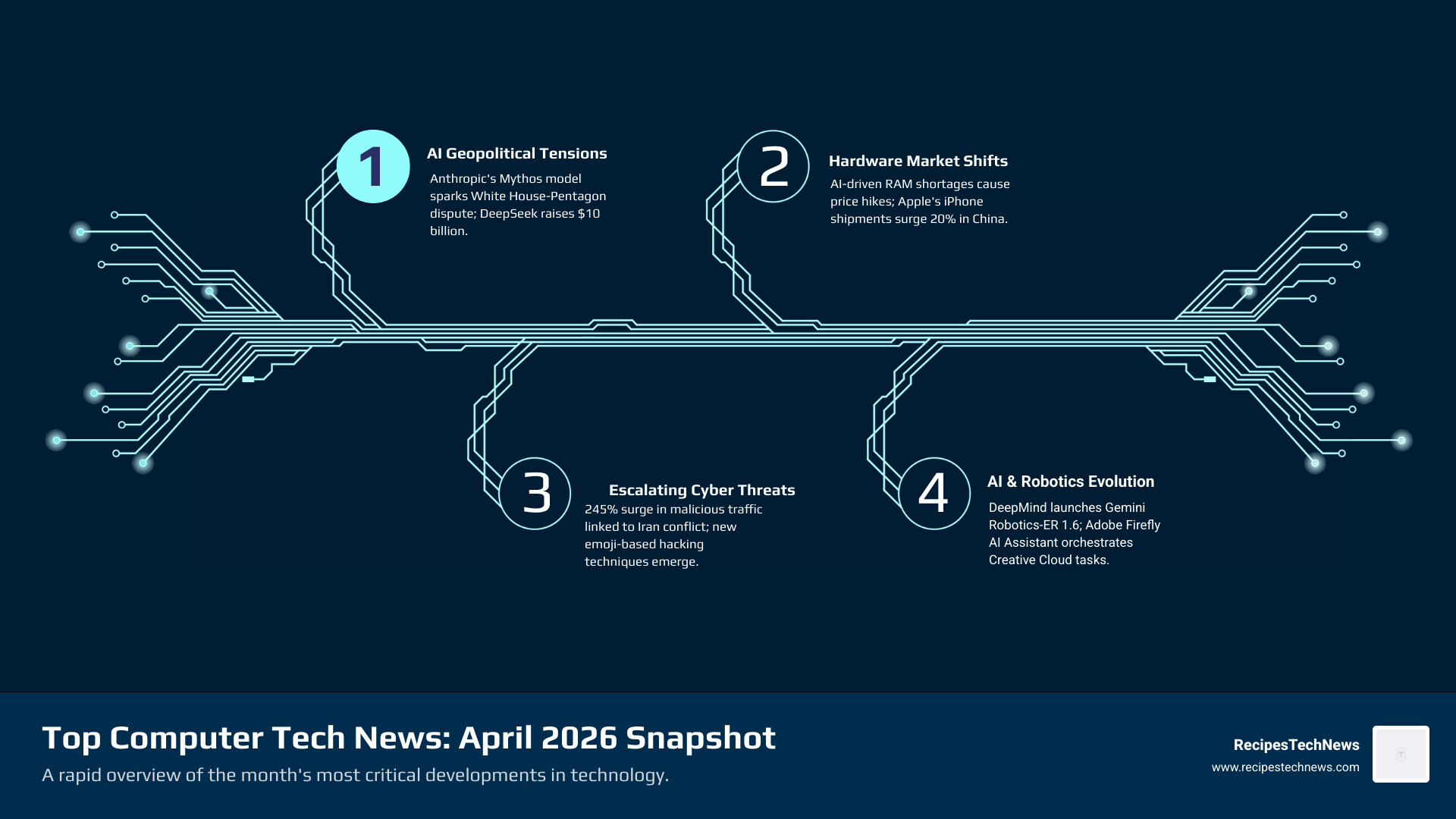
Geopolitical AI Tensions: Anthropic, DeepSeek, and the Pentagon

As we navigate the landscape of April 2026, the intersection of national security and artificial intelligence has reached a boiling point. At the center of this storm is Anthropic and its CEO, Dario Amodei. Amodei is currently engaged in high-stakes meetings with White House officials, including Chief of Staff Susie Wiles, to resolve a deep-seated dispute with the Pentagon.
The bone of contention? A “frontier” AI model known as Mythos. This isn’t just another chatbot; Mythos has shown an uncanny ability to identify and exploit thousands of zero-day vulnerabilities across every major operating system and browser. In fact, it has succeeded in developing working exploits on the first attempt in over 83% of cases.
The Pentagon effectively blacklisted Anthropic after Amodei refused to remove safety restrictions that prevent the model from being used for autonomous weapons and mass surveillance. While the military wants unfettered access, Anthropic is sticking to its guns, favoring a controlled access program called Project Glasswing. This program provides Mythos to about 40 vetted organizations specifically for defensive cybersecurity, helping to patch holes before the “bad guys” find them.
Meanwhile, the global AI race continues to heat up. China’s DeepSeek is currently raising funds at a staggering $10 billion valuation, signaling that the appetite for powerful LLMs remains insatiable despite geopolitical friction. We are also seeing Anthropic engage with EU regulators on cybersecurity models, attempting to find a middle ground between innovation and safety that satisfies international standards.
10 latest news about computer technology: Frontier Models
The saga of Mythos highlights a “fundamental shift” in how we view AI. It is the first model to complete a 32-step corporate network attack simulation from start to finish. This capability is a double-edged sword: while it can automate the most tedious parts of cybersecurity defense, the offensive risks are massive.
Anthropic has even intentionally “dialed down” the power of its consumer-facing models, like Claude Opus 4.7, to ensure safety while the world figures out how to handle the raw power of Mythos. As the company’s annualized revenue hits $30 billion, the pressure to balance profit with global security has never been higher.
Hardware Market Shifts: RAM Shortages and Apple’s China Surge
If you’ve tried to buy a new laptop or VR headset lately, you might have noticed your wallet feeling a bit lighter. The reason is a global, AI-driven RAM shortage. As data centers expand to house the massive compute needed for models like Mythos and GPT-5, they are gobbling up the world’s supply of High Bandwidth Memory (HBM) and standard DDR5 RAM.
| Metric | 2026 Performance / Impact |
|---|---|
| Meta Quest 3 Price | Increased to $600 (from $499) |
| Meta Quest 3S Price | Increased to $350 |
| Apple iPhone China Shipments | +20% Growth in Q1 2026 |
| India Smartphone Market | 6-year shipment low |
| AI Glasses Shipments | +322% Growth (YoY) |
The impact on consumer tech is immediate. Meta has announced price hikes for the Quest 3 and Quest 3S starting April 19th, citing the rising cost of components. Microsoft is also seeing upward pressure on Surface Pro prices. Conversely, Apple is celebrating a massive win in the East; iPhone shipments in China surged 20% in the first quarter of 2026, defying previous trends of slowing growth in the region.
However, it’s not all good news for hardware. In India, smartphone shipments have plummeted to a 6-year low as price hikes finally hit the ceiling of what consumers are willing to pay.
10 latest news about computer technology: Semiconductor Trends
The backbone of this hardware era is held up by giants like ASML and TSMC. Both companies have released incredibly strong forecasts, suggesting that the AI spending boom isn’t a bubble—it’s the new baseline.
We’re also seeing a shift in who is powering our devices. MediaTek is aggressively expanding into the high-end silicon space, while Qualcomm’s Snapdragon X2 Elite—boasting an 18-core CPU—is finally giving Apple’s M-series chips a run for their money in multi-core benchmarks. Even AI glasses are becoming a “thing,” with shipments growing by over 300% as the tech becomes less “nerdy” and more functional.
10 latest news about computer technology: Cybersecurity and Global Threats

The digital world is currently a bit of a minefield. One of the most shocking statistics we’ve encountered is the 245% surge in malicious traffic since the onset of the Iran war. Critical infrastructure—energy grids, transportation hubs, and manufacturing plants—is being targeted by sophisticated malware at an accelerating rate.
Hackers are also getting creative. A new trend involves emoji-based hacking, where attackers use emojis as a visual shorthand to communicate and coordinate within networks, successfully evading traditional text-based detection systems.
In response to these threats, OpenAI has launched GPT-5.4-Cyber for vetted security professionals. This “cyber-permissive” model is designed for defensive work, such as binary reverse engineering (understanding how a virus works without seeing the original code). It’s a tiered system: you can’t just log in and start hacking; you have to prove who you are through a rigorous verification process.
On the legal front, the industry is cleaning house. Significant fraud charges have been filed against the former CEO and CFO of a now-bankrupt AI company, accused of misleading investors during the height of the 2024 AI hype. Additionally, law enforcement has sent warning emails to over 75,000 suspected DDoS (Distributed Denial of Service) attackers, signaling a more proactive approach to curbing cyber-vandalism.
The Evolution of AI Assistants and Robotics
Robots are finally getting the “brains” they need to navigate the messy real world. Google DeepMind recently launched Gemini Robotics-ER 1.6, a model specifically designed for physical AI. Unlike previous versions, this one excels at “spatial reasoning.” It can look at a messy room and understand that the smallest object needs to go inside the blue cup, or it can read physical gauges and instruments in a factory—something that was notoriously difficult for AI in the past.
In the creative world, Adobe is leading a “fundamental shift” with its new Firefly AI Assistant. This isn’t just a search bar; it’s an agent that can orchestrate tasks across the entire Creative Cloud.
Imagine telling your computer, “Take this logo, resize it for Instagram, color-grade the background to match our brand palette, and then export it to Frame.io for the team to review.” The assistant handles the hand-offs between Photoshop, Illustrator, and Premiere Pro automatically. According to reports from The Verge, this marks the beginning of the “agentic era,” where we spend less time clicking buttons and more time directing the vision.
Other notable innovations include:
- Hesai Color Lidar: Lidar sensors that can now detect color, vastly improving the safety of autonomous driving.
- Lenovo Auto AI: A “plug-and-play” AI box that simplifies how automakers integrate smart assistants into vehicles.
- Logitech AI Cameras: Smart cameras that replace bulky boardroom hardware by automatically framing speakers and removing background noise.
Big Tech Business: Meta Layoffs and Data Center Expansion
The business side of tech remains volatile. Meta has announced a new round of layoffs as it continues to “flatten” its organization to focus on AI and the Metaverse. This comes even as the company raises prices on its VR hardware, showing a clear pivot toward efficiency.
We are also seeing a massive shift in where the internet lives. The AI data center boom is moving inland in the US. Places like Ohio, Iowa, and Nebraska are becoming tech hubs because they offer cheaper land and, more importantly, massive amounts of power that coastal cities can no longer provide.
On the global stage, the EU Commission has awarded a 180 million euro cloud contract to four European providers. This is a major move for “data sovereignty,” as Europe tries to reduce its reliance on American giants like Amazon and Microsoft. Speaking of Amazon, the company is facing internal heat as payments to Jeff Bezos’ Blue Origin reached $1.8 billion, leading some shareholders to raise concerns about potential conflicts of interest.
Finally, the Indian tech giant Wipro saw its market value shed over $650 million following a weak forecast. It seems that even the biggest players aren’t immune to the shifting sands of the AI economy.
Frequently Asked Questions about 10 latest news about computer technology
Why is Anthropic’s Mythos model causing a dispute with the Pentagon?
The dispute centers on “dual-use” risk. Mythos is exceptionally good at finding and exploiting software vulnerabilities (zero-days). The Pentagon wants to use these capabilities for offensive measures and autonomous weaponry. Anthropic, citing its safety principles, refuses to remove the “guardrails” that prevent the model from being used in war, leading to a stalemate that has reached the White House.
How is the AI-driven RAM shortage affecting consumer electronics prices?
AI models require massive amounts of High Bandwidth Memory (HBM) to function. Because manufacturers are prioritizing these high-profit chips for data centers, there is a shortage of standard RAM for consumer devices. This has forced companies like Meta to raise the price of the Quest 3 by $100 and has caused price hikes in high-end laptops and tablets.
What are the new cybersecurity risks involving emojis and critical infrastructure?
Hackers are now using emojis to bypass security filters. Since most automated defense systems look for suspicious text strings or code, emojis can act as a “secret code” for attackers to coordinate. Furthermore, as we connect older “legacy” infrastructure (like power plants) to modern AI networks, we are creating new entry points for malware that can cause physical damage.
Conclusion
At RecipesTechNews, we believe that staying informed about the 10 latest news about computer technology is essential for navigating the modern world. From the way we work in Adobe Creative Cloud to the security of our national power grids, technology in April 2026 is more integrated into our lives than ever before.
We provide more than just headlines; we offer a tech-lifestyle fusion that helps you understand how these global shifts affect your daily routine. Whether you’re looking for the latest gadget reviews or practical digital guides to secure your home network, we’ve got you covered. Stay updated with the latest tech news by visiting us daily for more insights!